An AI agent is only useful in engineering if it works like a good team member: it receives a precise task, investigates the file, documents what it found and submits its work for approval. That is how we designed the autonomous agents of the TriDyme platform.
Agents assigned like employees
On the platform, a task is assigned to an agent just as it would be to a colleague: manually, or automatically from a workflow. The agent reads the site, its documents and its equipment, then delivers:
- either a report, without writing anything to the portfolio;
- or proposed values on a branch, which a human reviews and merges.
Two separate settings frame its work:
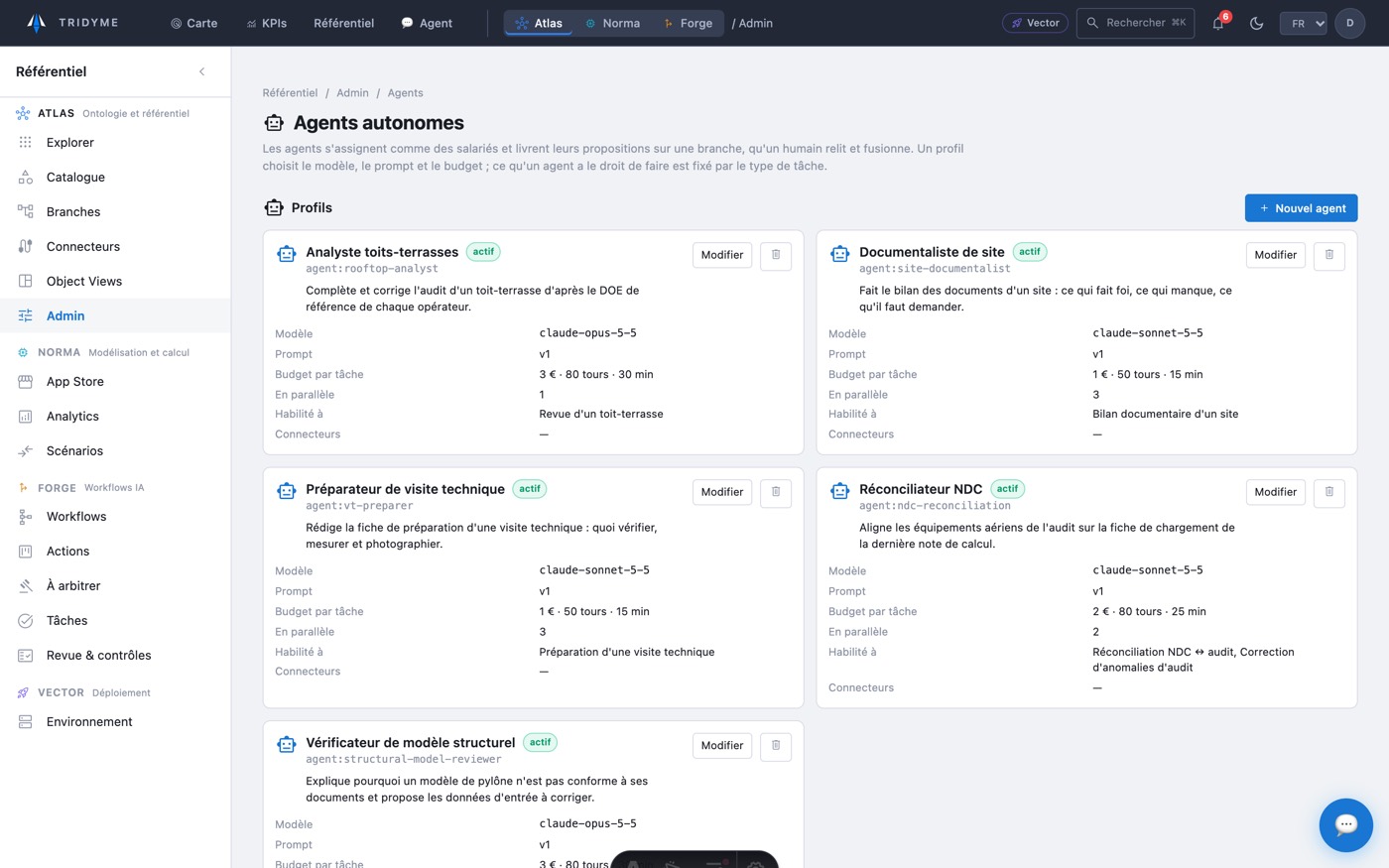
- the profile sets the AI model used, the (versioned) prompt and the budget per task: cost, number of steps, duration and tasks in parallel;
- the task type sets what the agent may do: the tools it can call and the actions it can launch. These permissions only change through a reviewed migration, never through a simple setting.
Six specialised agents
Site documentalist. Inventories a site’s documents: latest calculation note and latest as-built file (identified by the title-block date), detailed design, equipment sheet, health and safety file, lease; what is authoritative, what is missing, outdated or contradictory, and what to request from the client. It produces a report.
Site visit preparer. Writes the preparation sheet for a visit: what the audit does not know or cannot settle (missing data, discrepancies between calculation note and as-built file, foundation, access), the measurements and photos to take, and the safety points. It produces a report.
Design note reconciler. Compares the audit’s aerial equipment with the load sheet of the latest calculation note: mounting height, azimuths, operator, status, offset arms, dimensions, weight. It proposes corrections, each one sourced (document and page).
Rooftop analyst. Completes and corrects a rooftop audit based on each operator’s reference as-built file: supports, fixings, roof, waterproofing. It never removes a planned item of equipment.
Structural model reviewer. When a tower model does not comply, it compares the analysis result with the latest as-built file and calculation note, explains the discrepancy and proposes the input data to correct — never a calculated value.
Audit anomaly fixer. Resolves rule-check anomalies that deterministic fixes did not settle. What cannot be settled is flagged, not guessed.
Safeguards rather than blind trust
An agent’s autonomy is only valuable if it is framed. Several principles apply to every agent:
- Nothing reaches the portfolio without human approval. Proposals go on a branch; an engineer reviews the diff and decides.
- Every value is sourced. A proposal without a reference document and page is not acceptable.
- AI does not design the structure. Calculations are still run by the validated deterministic engine (why).
- Permissions come from the task type. An agent can only use the tools explicitly allowed for its assignment.
- External connectors are read-only by default. An agent can use third-party MCP servers only if both its profile and its task type allow it; any write to a third party needs explicit approval.
- Every task has a budget. Cost, number of steps and duration are capped.
Agents at the heart of workflows
Agents fit into Forge workflows like any other step: an “Autonomous agent” node assigns a task and waits for its outcome, before moving on, for example, to a human approval and then publication to the client’s system. You can chain document audit, structural analysis, review and correction, with an agent for the cases the rules cannot settle.
Key takeaways
- An agent receives a task, investigates the file and delivers a report or sourced proposals.
- The profile sets the model, prompt and budget; the task type sets the permissions.
- An engineer reviews and merges: the agent proposes, the human decides.
Give an agent its first task: discover autonomous AI agents and AI workflows, or talk to an expert.