Agents that work like team members
Agents are assigned like employees and deliver their proposals on a branch that a human reviews and merges. A profile sets the model, prompt and budget; what an agent may do is set by the task type.
A specialised team on your sites
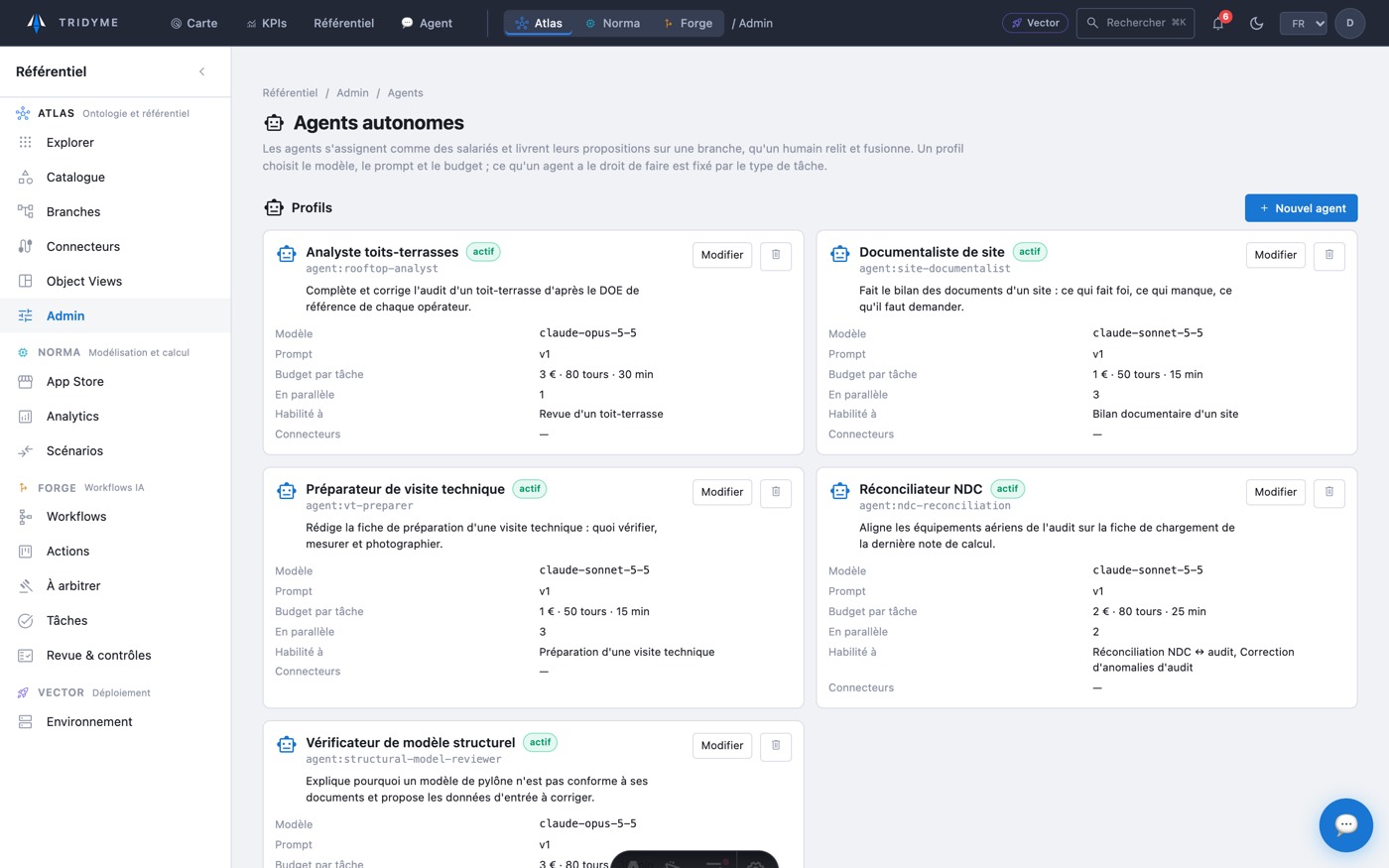
Site documentalist
Reviews a site’s documents: what is authoritative, what is missing, what to request from the client (latest design note, latest as-built file, preliminary design…).
Site visit preparer
Writes the preparation sheet for a technical visit: what to check, measure and photograph, and the safety points.
Design note reconciler
Aligns the audit’s aerial equipment with the load sheet of the latest calculation note; every correction is sourced (document and page).
Rooftop analyst
Completes and corrects a rooftop audit based on each operator’s reference as-built file.
Structural model reviewer
Explains why a tower model does not match its documents and proposes the input data to correct — never a calculated value.
Audit anomaly fixer
Resolves rule-check anomalies that deterministic fixes did not settle; what cannot be settled is flagged, not guessed.
From task to merge
- 1
A task is assigned
By an engineer or by a workflow, as to a team member.
- 2
It investigates
It reads the site, its documents and equipment, with only the tools the task type allows.
- 3
It proposes
A report, or sourced values on a branch; it can ask a human a question.
- 4
A human decides
The engineer reviews the diff and merges. Nothing reaches the portfolio without that approval.
Autonomy, under control
Proposals on a branch
An agent never changes the portfolio directly: it proposes, a human reviews and merges.
Permissions by task type
Allowed tools and actions are set by the task type, not the profile, and only change through a reviewed migration.
Every value sourced
Each proposal carries its source and justification; what cannot be settled is flagged.
Never a calculated value
AI does not design the structure: it proposes input data, the validated engine calculates.
Budget per task
Each profile has a budget: cost, number of steps, duration and tasks in parallel.
MCP connectors
Third-party MCP servers can be opened to agents, read-only by default; any write to a third party needs explicit approval.
Profiles and task types
Give an agent its first task
Document review, visit preparation or design note reconciliation: one use case is enough to get started.